For my perspective, that was too easy.
I did make a plan and execute it perfectly - I had the Command Cards to do it.
The Dwarf army had a couple of turns when it couldn't move any forces. I'm not sure if that would have made any difference. The Dwarf forces probably needed a Defence posture at the beginning, dug in and waited for my attack.
There are a number of Command Cards in the deck that allow the non-player army to order units and then play another card. The Dwarf army didn't draw any of these. I think that I will have to increase the number of these cards.
The main problem for the Dwarves was that they had three units off-table - the scouts that returned late plus the two reserve units. They didn't draw a Deployment card so these forces never appeared. I need to work out if this was a fluke, or whether I need to change the card distribution.
Nonetheless, I really enjoyed that!
Showing posts with label Game design. Show all posts
Showing posts with label Game design. Show all posts
Sunday, 15 January 2012

Saturday, 14 January 2012
Points - victory or otherwise.
Each unit in the army has a points value, from 2 points for a Hordes unit up to 12 points for a Deity or Dragon.
Each army is consists of 80 points worth of troops.
Destroying an opposing unit gains Victory Points (VPs) equal to the points value of the unit.
Some scenarios have objectives (worth 10 VPs) or other additional methods of scoring VPs.
If at the end of a turn one side has 40 or more VPs and more VPs than the opposing side then it has won.
If one army has 20 or more VPs then the opposing army is Demoralized. When attacking a Demoralized unit in close combat, the attacker gains a +1 tactical modifier.
Thursday, 12 January 2012
The Game Turn
Each turn during the battle will go something like this:
(The human player will be referred to as the player. The other army will be referred to as the enemy)
1) Command Phase
If is the player's turn:
Draw the top card from the Command Card deck and resolve the event on the card.
Play one card from your hand of Command Cards. Mark any units that are being ordered by the card.
If it is the enemy's turn:
Play the top card of the Command deck. Mark any units that are being ordered by the card. Some cards in the deck will allow the enemy to draw another card and order further units.
When ordering units:
Two units that have the attribute "Drilled" may be ordered as though they were one unit.
Any number of units that are of the same type, adjacent to each other and facing in the same direction can be ordered as though they were one unit.
2) Movement Phase
Move ordered units.
3) Combat Phase
Resolve ranged combat.
Resolve close combat.
Note that, unlike in Battlelore, all of an army's units that are capable of attacking will do so. Units do not have to be ordered to be able to attack. This resolves another of my problems with the Battlelore combat system.
4) Draw Phase
Check winning conditions.
If one side has 40 or more Victory Points and more Victory Points than the opposing army, that side has won. I will cover Victory Points in another post.
If it is the player's turn:
You may either draw one Lore Card OR roll to gain Lore Tokens. I'll cover the Lore rules more fully in another post.
Draw one Command Card.
If you have more than the maximum permitted Command Cards or Lore Cards, discard down the the minimum.
Maximum Command Cards allowed are 4/5/6 for an inferior/average/superior commander. Maximum Lore Cards allowed are 3 per unit that has a Lore attribute.
If it is the enemy's turn:
The enemy will draw a Lore Card if the army has less than the maximum permitted AND will roll to gain Lore Tokens.
Tuesday, 10 January 2012
Scenario Generator
If there's one thing that I wanted to get away from, it's the tendency for a wargame to have two armies line up facing each other and fighting until x number of units have been destroyed. This still should be a frequent happening, but I feel that there should be other scenarios that result from an encounter between two armies.
Before the battle starts, the player must pick a stance: Attack, Defend or Recon.
The opposing commander will have a reputation: Cautious, Bold or Rash.
After the player has picked his stance, roll 1 die to determine the opposition's stance. Cautious commanders subtract 1 from the roll. Rash commanders add 1 to the roll.
Result Stance
2 or less Defend
3 or 4 Recon
5 or more Attack
Now we come to the concept of scouting. The player must select which units, if any, he wishes to use as scouts. Each unit selected is worth a number of scouting points:
4 points Flyers, Airships, Magicians, Rogues.
3 points Mounted Archers.
2 points Skirmishers, Auxiliaries, Lurkers, Cavalry.
1 point Other troop units.
A maximum number of one third (rounded down) of the units in the army may be selected as scouts.
The opposing army has a pool of potential scouts equal to the maximum number of scouts that could be picked, starting with units worth the most scouting points.
To determine which of these units are selected as scouts, roll 1 die for each unit. A unit is selected if a 4 or more is rolled. Cautious commanders add 1 to this roll, Rash commanders subtract 1.
Each army adds together the the scouting points of units selected as scouts. Each side adds 2 to this total if the army commander is rated as average, and 4 to this total if rated as superior. Each side also adds the roll of 1 die.
After scouting, roll 1 die for each unit that was selected to scout. On a 1 or 2, something has happened to that unit. Roll another die. On a 1 or 2, the unit is destroyed. On a 3 or 4, the unit misses the battle. On a 5 or 6, the unit is late for the battle and is placed with the army's reserves.
Compare the total scouting scores of the two armies. If one side scores three times or more the total of the other, the lower scoring army is surprised, otherwise the lower scorer is outscouted.
Scenario Outcome Table
Attack Recon Defend
outscouts Pitched Battle Pitched Battle Assault
Attack tied with Special* Special* Assault Special*
surprises Surprise Attack Surprise Attack Surprise Assault
outscouts Pitched Battle Skirmish Assault
Recon tied with Special* Special* Special*
surprises Ambush Ambush Surprise Assault
outscouts Assault Assault Skirmish
Defend tied with Assault Special* Special* Disputed Border
surprises Trap Trap Trap
Special scenarios. Roll 1 die:
1 Seize Magic Item
2 Wizard's Tower
3 Treasure Raid
4 Dragon's Lair
5,6 Surprise Encounter
Assault Special scenarios. Roll 1 die:
1 or 2 River Crossing
3 or 4 Urban Assault
5 or 6 Amphibious Landing
Pitched Battle is your standard line 'em up and knock 'em down scenario.
Assault requires the defender to select a stronghold, which is a fortification and also counts as an objective, worth Victory Points to whomever is holding it. An Assault scenario may instead be a Siege if the defender has a castle in the area.
Ambush has the surprised army set up in the middle of the board with all it's units disorganized - each unit must be ordered once to remove the disorganization before it can be ordered to move.
Surprise Assault is the same as an Assault but the defending army is disorganized.
Skirmish has neither army set up on the board at the start. Each army scores victory points by moving units off the opposing army's base edge.
Trap has the attacking army disorganized. The defending army can place field defences and infiltrate some troop units which can be deployed anywhere on the board.
Disputed Border has both armies dug in and a town in the middle of the board, the town being an objective worth victory points.
The first four Special scenarios all have the relevant pieces placed in a random location on the board.
A surprise encounter has both armies disorganized.
River crossing has a river running across the middle of the board. The attacking army receives Victory Points for units that cross the river.
Urban Assault has a large town on the board which counts as an objective.
Amphibious Landing requires the attacking player to use boats to land troops.
That's 15 different scenarios, and enough variety to keep me happy!
Before the battle starts, the player must pick a stance: Attack, Defend or Recon.
The opposing commander will have a reputation: Cautious, Bold or Rash.
After the player has picked his stance, roll 1 die to determine the opposition's stance. Cautious commanders subtract 1 from the roll. Rash commanders add 1 to the roll.
Result Stance
2 or less Defend
3 or 4 Recon
5 or more Attack
Now we come to the concept of scouting. The player must select which units, if any, he wishes to use as scouts. Each unit selected is worth a number of scouting points:
4 points Flyers, Airships, Magicians, Rogues.
3 points Mounted Archers.
2 points Skirmishers, Auxiliaries, Lurkers, Cavalry.
1 point Other troop units.
A maximum number of one third (rounded down) of the units in the army may be selected as scouts.
The opposing army has a pool of potential scouts equal to the maximum number of scouts that could be picked, starting with units worth the most scouting points.
To determine which of these units are selected as scouts, roll 1 die for each unit. A unit is selected if a 4 or more is rolled. Cautious commanders add 1 to this roll, Rash commanders subtract 1.
Each army adds together the the scouting points of units selected as scouts. Each side adds 2 to this total if the army commander is rated as average, and 4 to this total if rated as superior. Each side also adds the roll of 1 die.
After scouting, roll 1 die for each unit that was selected to scout. On a 1 or 2, something has happened to that unit. Roll another die. On a 1 or 2, the unit is destroyed. On a 3 or 4, the unit misses the battle. On a 5 or 6, the unit is late for the battle and is placed with the army's reserves.
Compare the total scouting scores of the two armies. If one side scores three times or more the total of the other, the lower scoring army is surprised, otherwise the lower scorer is outscouted.
Scenario Outcome Table
Attack Recon Defend
outscouts Pitched Battle Pitched Battle Assault
Attack tied with Special* Special* Assault Special*
surprises Surprise Attack Surprise Attack Surprise Assault
outscouts Pitched Battle Skirmish Assault
Recon tied with Special* Special* Special*
surprises Ambush Ambush Surprise Assault
outscouts Assault Assault Skirmish
Defend tied with Assault Special* Special* Disputed Border
surprises Trap Trap Trap
Special scenarios. Roll 1 die:
1 Seize Magic Item
2 Wizard's Tower
3 Treasure Raid
4 Dragon's Lair
5,6 Surprise Encounter
Assault Special scenarios. Roll 1 die:
1 or 2 River Crossing
3 or 4 Urban Assault
5 or 6 Amphibious Landing
Pitched Battle is your standard line 'em up and knock 'em down scenario.
Assault requires the defender to select a stronghold, which is a fortification and also counts as an objective, worth Victory Points to whomever is holding it. An Assault scenario may instead be a Siege if the defender has a castle in the area.
Ambush has the surprised army set up in the middle of the board with all it's units disorganized - each unit must be ordered once to remove the disorganization before it can be ordered to move.
Surprise Assault is the same as an Assault but the defending army is disorganized.
Skirmish has neither army set up on the board at the start. Each army scores victory points by moving units off the opposing army's base edge.
Trap has the attacking army disorganized. The defending army can place field defences and infiltrate some troop units which can be deployed anywhere on the board.
Disputed Border has both armies dug in and a town in the middle of the board, the town being an objective worth victory points.
The first four Special scenarios all have the relevant pieces placed in a random location on the board.
A surprise encounter has both armies disorganized.
River crossing has a river running across the middle of the board. The attacking army receives Victory Points for units that cross the river.
Urban Assault has a large town on the board which counts as an objective.
Amphibious Landing requires the attacking player to use boats to land troops.
That's 15 different scenarios, and enough variety to keep me happy!
Monday, 9 January 2012
Unit Types
I have created a mish-mash of unit types. Each of these has slightly different characteristics. Along with rating each unit as Superior, Average or Inferior - and adding different attributes where necessary - allows me to create an army list quickly and easily but which still has a great deal of individuality.
Lore units
Lore units are powerful units that do not fit into the other categories. They have there own category so that rules that specifically affect troop units or characters do not apply to them.
Deity
Any god, demon or similarly powerful supernatural creature. Powerful, but will be driven off the field if it loses any combat. Will draw Lore Cards of a type dependant on the Deity's role - for instance a Fire God would draw Fire Lore Cards.
Dragon
Similarly powerful to a Deity, but has a ranged attack to represent it's breath weapon as opposed to a Deity's Lore Cards.
Airship
A large, single airborne unit. Will either be of advanced technology or magically powered, but the results are treated the same either way.
Monster
A big, nasty critter. Giants, Trolls and the suchlike belong in the category.
Characters
Representing not just a single powerful individual but also, possibly, such things as a coven of witches or a hero and his entourage.
Hero
A warrior - the character type that excels at beating up the enemy. Normally draws Warrior Lore Cards to represent special abilities.
Paladin
He has the strength of ten as his heart is pure. Also very resistant to opponent's Lore Cards. Powerful, but does not draw Lore Cards.
Rogue
Any character that use stealth as opposed to muscle to achieve his ends. Thieves, rangers and assassins, for instance. Normally draws Stealth Lore Cards.
Magician
Sorcerers, wizards...you get the drift. Normally draws Sorcery Lore Cards.
Cleric
Priests and shaman. Resistant to opponent's Lore Cards, and normally draws Priest Lore Cards.
Musician
Cheap and rather useless on their own, but they do lend support to nearby units. Does not normally draw Lore Cards.
Troop units
The rank and file of an army.
Flyer
Any aerial troops - from winged demons to swarms of bats.
Cavalry
Bog standard mounted troops. The mounts themselves do not matter, although troops mounted on more aggressive animals will tend to be graded as Superior troops.
Elephants
Troops mounted on elephants, mammoths or similar creatures.
Chariots
Troops in chariots. Nuff said.
Beasts
Smaller creatures that fight in packs or swarms - lizards, rats and sabre-tooth tigers are examples that spring to mind from the army lists.
Swords
Foot troops fighting effectively with bladed, cutting or concussive weapons.
Spears
Foot troops armed with spears or pikes fighting as a shield wall or phalanx.
Shooters
Foot troops armed with missile weapons fired as volleys from a distance.
Artillery
Catapults ranging in size from a ballista to a trebuchet, and weapons of a similar effect.
Lurker
Troops that lurk in dark corners and try to take the enemy by surprise. Scouts and some creepy crawlies can fall into this category.
Horde
Peasants, zombies and anyone else fighting by force of numbers rather than any real skill. There's an almost limitless supply of them!
Skirmishers
Foot troops armed with missile weapons but fighting up close in a loose formation, ready to run away from a combat they're not winning.
War Wagons
War Wagons, battle towers, steam tanks and the like. Fairly hard and they have a ranged attack.
Mounted Archers
The mounted equivalent of Skirmishers.
Knights
Like cavalry, but most effective when charging.
Warband
Fierce tribal warriors. Like Knights, most effective when charging.
Gunners
Foot troops armed with handguns. muskets or something similar. They are slightly more effective than Shooters but cannot move and fire in the same turn.
Cannon
Bombards and big guns. Slightly longer ranged and more effective than artillery.
Bombardiers
They've got grenades and they know how to use them. Kind of. Dangerous to all around them.
Expendables
Historically this would cover scythed chariots and the like, but expanded here to include Goblin Steam Cars and anything else that you would point at the enemy and let go.
Auxilia
Lightly equipped close combat troops, good performers in bad going and capable of evading close combat.
Baggage
Army supplies. Gives a small bonus to an army if in play, but also gives the opposing army victory points if destroyed.
And finally four ship units of increasing size, included for beach landing scenarios and the added bonus of naval battles when the full campaign gets going:
Boat
Sloop
Galley
Warship
You may notice that Commander is not listed as a troop type. The Commander must be nominated from the units in the army. and may be any unit allowed by a given army list.
Sunday, 8 January 2012
More Cards
There are a few more things that I wanted to add to the game. Firstly, stratagems - think along the lines of flank marches or reserve forces. 24 cards designed. A superior commander draws 2 cards from the deck, and average commander 1 card. Inferior commanders don't get any at all. This is one of the game elements that hasn't been play tested yet.


Example stratagem card

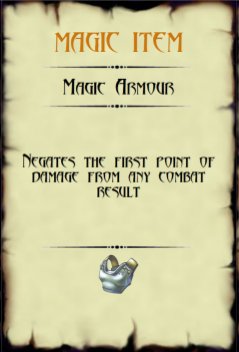
And what is a fantasy game without magic items? I have designed an 18 card magic item deck. If allowed by an army list, an army may purchase the top 1 or 2 cards from the deck. Again, these have yet to be play tested. Only characters will be able to use magic items.
Example magic item card
Cards
Having redesigned Battlelore's combat rules, I then ran into another problem. The areas of Battlelore that I wished to retain - the command rules and the lore rules - both relied on cards that didn't fit in with the redesigned combat rules. So all the cards need to be redone as well!
The cards have been designed using Nandeck, which is a rather useful bit of kit for anyone designing their own games.
First up, the command cards. I didn't need to do much work here. The main change is that as I no longer have troops defined by banner colour, the cards that order troops by banner colour are redundant. Instead, I added Deployment cards. Some units are not deployed on the board at the start of the game - either due to the unit type (e.g. Deity, Lurkers), due to stratagem cards (more on them later) or due to scenario limitations. The Deployment card allows these units to be placed on the board.


The cards have been designed using Nandeck, which is a rather useful bit of kit for anyone designing their own games.
First up, the command cards. I didn't need to do much work here. The main change is that as I no longer have troops defined by banner colour, the cards that order troops by banner colour are redundant. Instead, I added Deployment cards. Some units are not deployed on the board at the start of the game - either due to the unit type (e.g. Deity, Lurkers), due to stratagem cards (more on them later) or due to scenario limitations. The Deployment card allows these units to be placed on the board.
An example of a command card

I have made the command cards dual use - they also function as event cards. At the beginning of the player's turn, one command card is drawn and the event is resolved. Some command cards have no events, most just modify the score on the weather table (more on the weather rules later). A few cards have more interesting effects. The event portion of the card is ignored in other circumstances. I have shamelessly stolen this mechanic from Combat Commander: Pacific, a game which I love.
Slightly more work went into the lore cards. I wanted to expand the number of lore decks available from the four in the basic Battlelore game. This would give certain characters and races a different set of powers, helping to further differentiate between different armies and adding more flavour to the game without adding complexity. And as the lore cards often effect combat, most of them had to be amended as well.
An example of a lore card

I have only completed the four basic lore decks - Warrior, Sorcery, Stealth and Priest. Other decks in the works include: Earth, Air, Fire, Water, Rune, Vampire, Necromancy, Demon, Illusion, Forest, Beast Master, Death, Assassin, Master Baker (for the Halflings!), Ice, Lore Mastery, Lycanthropy and Drum Lore!
I just noticed an error in the above card - the duration should be "One Turn" rather than "Immediate". Oh well, I knew this was going to be the first draft.
The four basic lore decks all have 13 cards. The other lore decks probably won't have as many - I'm looking at a minimum of 7 cards and always making it an odd number. This would be so that 1 card can be discarded at random and the rest of the deck shared between the armies if both armies have a unit capable of using that particular lore deck. Most of those additional decks have been written up, I just need to design the cards themselves.
Saturday, 7 January 2012
The Emperor's New Combat Rules
The Hordes of the Things (HOTT) rules set defines units by troop types, reflecting not just the unit's weapons but also how the unit would be used on the battlefield. As I was adapting the HOTT combat rules, I would adopt a similar convention.
As an example, "Horde" would be defined as a unit comprising an untrained rabble with assorted close combat weapons. "Blades" would be troops skilled in close combat with swords or heavier cutting weapons. HOTT has a rather restrictive number of unit types, which I expanded by importing more historical troop types from the related historical rules sets, and adding a few of my own creation. There are now 36 unit types, which may be a little excessive but also gives great variety.
Each unit type has two definitions that accompany it. A unit must be foot, mounted, aerial or water-born, depending on it's primary method of movement. A unit also must be a troop unit, a character or a lore unit. A troop unit represents a body of fighting men, a character represents one heroic individual (probably with a small entourage), a lore unit represents those fantasy units that don't fall into the other categories - Deity, Dragon, Airship and Monster as it currently stands.
A unit must also be defined as either superior, ordinary or inferior, and can be assumed to be ordinary unless otherwise stated.
There also a number of special rules that may apply to a unit. I have dubbed these attributes. Some of these are automatically applied to a unit type, e.g. A unit of Skirmishers always has the Evade attribute. Any attributes may be applied to a unit type - these will be defined in the army lists for each army, giving more variety to the armies.
One of the few things carried over from Battlelore is the damage to the unit, although instead of removing figures as hits are inflicted on the unit, damage markers are placed by the unit. If a troop or lore unit takes 4 hits, it is destroyed. A character can take only a single hit before being destroyed. However, a character can also be used to lead a troop unit, which improves the troop unit's performance in combat and means that the character will not take any damage until the unit (s)he is leading is destroyed. This makes characters powerful but brittle when used on their own - it's a high risk tactic.
Combat Resolution
Each unit has a combat factor which ranges from 1 to 5. For example. a Blades unit has a combat factor of 3 against foot troops and 2 against mounted troops. A Hordes unit has a combat factor of 1.
There are also a number of tactical factors. For example, attacking the flank or rear of an enemy unit has a tactical factor of 1. Attacking a unit that has 2 or more damage markers also has a tactical factor of 1.
To resolve combat:
1) Add together the combat factor and tactical factors for each side. Subtract the enemy unit's combat factor from your unit's combat factor to give the total factor.
2) Roll an 8 sided die and add the total factor. Look up the result on the table below.
3) Total Result
-1 or less Your unit is destroyed.
0 or 1 Your unit is heavily damaged.
2 to 4 Your unit is damaged.
5 to 7 Enemy unit is damaged.
8 or 9 Enemy unit is heavily damaged.
10 or more Enemy unit is destroyed.
4) If your unit is of superior quality, the enemy's is not and the score is 4 or less, add 1 to the result.
If your unit is of inferior quality, the enemy's is not and the score is 4 or less, subtract 1 from the result.
If the enemy unit is of superior quality, yours is not and the score is 5 or more, subtract 1 from the result.
If the enemy unit is of inferior quality, yours is not and the score is 5 or more, add 1 to the result.
5) A damaged unit receives one point of damage and is pushed back 1 hex.
If the unit has the Evade attribute, it does not take damage but instead makes an evade move.
A heavily damaged unit has the same outcome as a damaged unit but takes an extra point of damage.
A destroyed unit routs and takes a point of damage if it has the Evade attribute.
If it does not have the Evade attribute, the unit is removed from the board.
I have left a few things out to simplify this post, but there you have it - the bare bones of the combat system.
As an example, "Horde" would be defined as a unit comprising an untrained rabble with assorted close combat weapons. "Blades" would be troops skilled in close combat with swords or heavier cutting weapons. HOTT has a rather restrictive number of unit types, which I expanded by importing more historical troop types from the related historical rules sets, and adding a few of my own creation. There are now 36 unit types, which may be a little excessive but also gives great variety.
Each unit type has two definitions that accompany it. A unit must be foot, mounted, aerial or water-born, depending on it's primary method of movement. A unit also must be a troop unit, a character or a lore unit. A troop unit represents a body of fighting men, a character represents one heroic individual (probably with a small entourage), a lore unit represents those fantasy units that don't fall into the other categories - Deity, Dragon, Airship and Monster as it currently stands.
A unit must also be defined as either superior, ordinary or inferior, and can be assumed to be ordinary unless otherwise stated.
There also a number of special rules that may apply to a unit. I have dubbed these attributes. Some of these are automatically applied to a unit type, e.g. A unit of Skirmishers always has the Evade attribute. Any attributes may be applied to a unit type - these will be defined in the army lists for each army, giving more variety to the armies.
One of the few things carried over from Battlelore is the damage to the unit, although instead of removing figures as hits are inflicted on the unit, damage markers are placed by the unit. If a troop or lore unit takes 4 hits, it is destroyed. A character can take only a single hit before being destroyed. However, a character can also be used to lead a troop unit, which improves the troop unit's performance in combat and means that the character will not take any damage until the unit (s)he is leading is destroyed. This makes characters powerful but brittle when used on their own - it's a high risk tactic.
Combat Resolution
Each unit has a combat factor which ranges from 1 to 5. For example. a Blades unit has a combat factor of 3 against foot troops and 2 against mounted troops. A Hordes unit has a combat factor of 1.
There are also a number of tactical factors. For example, attacking the flank or rear of an enemy unit has a tactical factor of 1. Attacking a unit that has 2 or more damage markers also has a tactical factor of 1.
To resolve combat:
1) Add together the combat factor and tactical factors for each side. Subtract the enemy unit's combat factor from your unit's combat factor to give the total factor.
2) Roll an 8 sided die and add the total factor. Look up the result on the table below.
3) Total Result
-1 or less Your unit is destroyed.
0 or 1 Your unit is heavily damaged.
2 to 4 Your unit is damaged.
5 to 7 Enemy unit is damaged.
8 or 9 Enemy unit is heavily damaged.
10 or more Enemy unit is destroyed.
4) If your unit is of superior quality, the enemy's is not and the score is 4 or less, add 1 to the result.
If your unit is of inferior quality, the enemy's is not and the score is 4 or less, subtract 1 from the result.
If the enemy unit is of superior quality, yours is not and the score is 5 or more, subtract 1 from the result.
If the enemy unit is of inferior quality, yours is not and the score is 5 or more, add 1 to the result.
5) A damaged unit receives one point of damage and is pushed back 1 hex.
If the unit has the Evade attribute, it does not take damage but instead makes an evade move.
A heavily damaged unit has the same outcome as a damaged unit but takes an extra point of damage.
A destroyed unit routs and takes a point of damage if it has the Evade attribute.
If it does not have the Evade attribute, the unit is removed from the board.
I have left a few things out to simplify this post, but there you have it - the bare bones of the combat system.
Designing The Combat Rules
My problems with Battlelore
I find combat resolution in Battlelore a little odd at times. A unit at full strength is represented by four figures - three figures if a cavalry unit. Each hit on the unit removes one figure. When the last figure is removed, the unit is destroyed. Units are further defined by the weapon they are using, and by the colour of their banner - red, green or blue, equivalent to heavy, medium or light units.
When attacking, a unit usually rolls four dice. These are 6 sided dice, but with symbols on each face: 1 Red, 1 Blue, 1 Green, 1 Flag, 1 Bonus Hit, 1 Lore. An attacking unit scores one hit on it's opponent for each dice that rolls same banner colour of the unit it is attacking. It may score a hit when rolling a bonus hit, depending on the weapon used and the opponent. Each flag rolled causes the opposing unit to retreat 1 hex.
Things I don't like:
1) The attacking unit does not have any penalty for being at less than full strength. A unit with 1 figure remaining rolls the same number of attack dice as a unit with all 4 figures remaining.
2) Whether the target is a red, blue or green banner unit makes no difference. A "heavy" unit suffers just as many hits as a "light" unit.
I tried two different approaches to amending the rules.
The First Attempt
I tried to keep to the rules as they stood as much as possible.
The solution to problem one seemed straightforward - roll one attack dice per figure in the attacking unit. This prolongs combat as less dice will be rolled over the course of the game. To counteract this, I bought some blanks and remade the combat dice: 2 Hit faces, 1 Bonus Hit, 1 Flag, 1 Miss, 1 Lore. Hits are no longer made by rolling a banner colour, but by rolling a "hit".
To resolve problem two I introduced a saving throw. Reroll any dice that are hits. A hit on a blue banner unit is saved if a miss is rolled, a hit on a red banner unit is saved by a roll of a miss or a lore.
I play tested and tweaked these amendments on and off for a long time. I didn't like the amount of dice rolling involved, and I could never balance combat to my satisfaction. This gave me an appreciation about how well balanced the original rules are, despite my dislike of parts of them!
The Second Attempt
There is a set of fantasy wargame rules called Hordes of the Things. I had played around with these rules a long time ago, using scraps of card instead of miniatures. These rules are based on De Bellis Antiquitatis, a set of rules for historical wargames set in the ancient period which I had used extensively. Hordes of the Things fails as a set of fantasy rules as it has little fantasy flavour. But could I drop the combat rules from Hordes of the Things into Battlelore? It took a lot a playtesting and tweaking, but I got there in the end.
Game Design
Overall Design
There will be two separate parts to the game - the battle rules and the campaign rules.
The Rules
A couple of years ago I bought Battlelore. It's an enjoyable fantasy battle game. Although not designed for solitaire play, the card-based system for ordering units makes in very suitable for solo gaming. I blasted through all the scenarios included in the base game, and in the expansions that I purchased.
Although I like Battlelore a great deal, I still have some problems with it.
1) I feel that the quality and value for money of the expansions has taken a nose dive since Days on Wonder sold the rights to the game to Fantasy Flight Games.
2) There are several aspects to the combat system that I don't like. Don't get me wrong - I think the combat system works reasonably well and is balanced in the original game. But I still don't like it much.
3) There needs to be a decent scenario generator. The deployment cards in the Call to Arms expansion are a failure in this respect.
4) There is no campaign game.
5) The basic Battlelore game does not have heroes or other characters on the board. They are off-board, as part of a "Lore Council" that allows the player to play "Lore Cards". Again, this works pretty well in the original game but still isn't the way I'd like things done - I want my heroes in the thick of things, kicking ass and occasionally getting killed. The Heroes expansion should have fixed this, but after reading the rules and reviews I decided not to purchase it as I didn't like the way Heroes were being handled.
However, there are quite a few things that I do like about it.
1) Battlelore's card driven command system is a good basis for a solo game.
2) The Lore cards. These give special abilities and lend the game a strong fantasy flavour.
3) Hex board. No measuring to see if a unit is in range or can make a flank attack, where a difference of a couple of millimetres can be crucial.
I decided to base Arcadia on a modified form of Battlelore. The first thing I decided to tackle was the combat system.
There will be two separate parts to the game - the battle rules and the campaign rules.
The Rules
A couple of years ago I bought Battlelore. It's an enjoyable fantasy battle game. Although not designed for solitaire play, the card-based system for ordering units makes in very suitable for solo gaming. I blasted through all the scenarios included in the base game, and in the expansions that I purchased.
Although I like Battlelore a great deal, I still have some problems with it.
1) I feel that the quality and value for money of the expansions has taken a nose dive since Days on Wonder sold the rights to the game to Fantasy Flight Games.
2) There are several aspects to the combat system that I don't like. Don't get me wrong - I think the combat system works reasonably well and is balanced in the original game. But I still don't like it much.
3) There needs to be a decent scenario generator. The deployment cards in the Call to Arms expansion are a failure in this respect.
4) There is no campaign game.
5) The basic Battlelore game does not have heroes or other characters on the board. They are off-board, as part of a "Lore Council" that allows the player to play "Lore Cards". Again, this works pretty well in the original game but still isn't the way I'd like things done - I want my heroes in the thick of things, kicking ass and occasionally getting killed. The Heroes expansion should have fixed this, but after reading the rules and reviews I decided not to purchase it as I didn't like the way Heroes were being handled.
However, there are quite a few things that I do like about it.
1) Battlelore's card driven command system is a good basis for a solo game.
2) The Lore cards. These give special abilities and lend the game a strong fantasy flavour.
3) Hex board. No measuring to see if a unit is in range or can make a flank attack, where a difference of a couple of millimetres can be crucial.
I decided to base Arcadia on a modified form of Battlelore. The first thing I decided to tackle was the combat system.
Subscribe to:
Posts (Atom)